


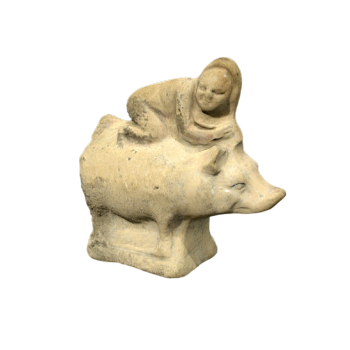
Ancient Greek clay sculpture "child riding a pig"
The statue dates back to the Hellenistic period (3rd to 1st century BC) and may have come from southern Greece or southern Italy. In ancient Greek culture, pigs or wild boars were considered the patron saint of young children and had the function of warding off evil spirits. This image may represent Eros riding on a wild boar, or depict a carefree child.

Centuripe pottery
It is a product of the Hellenistic period (3rd century BC to 2nd century BC), known for its exquisite decoration and colorful glaze. This type of pottery is commonly used in tombs and has important cultural and symbolic significance. The characteristics of Centuripe pottery are its complex decorative applications and exquisite post firing painting. Usually depicting wedding scenes, such as the bride being surrounded by bridesmaids, reflecting the social customs and religious beliefs of the time. These funeral pottery pieces are not only works of art, but also important materials for studying ancient Sicilian culture and religion. It demonstrates the profound influence of ancient Greek culture on Sicily.

3D model of cup replica from the late geometric period of ancient Greece
It is a replica of the late geometric period of ancient Greece (approximately 800 BC to 700 BC). The depiction of horses and figures in geometric style reflects the artistic characteristics of that era. Geometric style artworks typically depict characters and animals in abstract form, using simple lines and geometric shapes. The replica of this cup is not only a work of art, but also a tribute to ancient Greek culture and art. It may have been used in ceremonies or banquets, and the design of the lid may help maintain the freshness and temperature of the beverage.
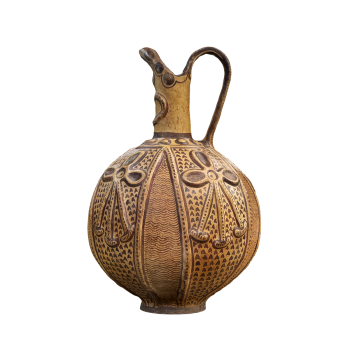
Barbotine style ceremonial teapot replica 3D model
Featuring relief decorations, it imitates artifacts from the late Minoan II-III period around 1450 BC to 1100 BC. This style of pot has significant historical and artistic value in ancient Greek culture. The decorative technique of using mud on the surface of pottery. This technique involves applying a layer of mud on the unburned surface of pottery, and then carving patterns or reliefs on it. The pottery of the Late Minoan period is renowned for its exquisite craftsmanship and unique artistic style. These replicas are a tribute to the art of ancient civilizations and also provide a way for modern collectors to appreciate and learn ancient art.

Owl Red Painted Pottery Bottle - Igleio Archaeological Museum
It is a type of pottery from ancient Greece, characterized by the use of red to depict patterns and scenes on a black background of the pottery. The production technology originated in the 6th century BC and remained popular until the 4th century BC. It is often used to contain oil, perfume or other liquids, and it is also often used as burial goods, and sometimes used in religious ceremonies. This pottery bottle is from the Kamarina region of Sicily, Italy, and belongs to the classical period. It was made around the 5th century BC. The surface depicts the image of an owl, which has important symbolic significance in ancient Greek culture and is often used in art and literary works. It is currently housed in the Igleio Archaeological Museum in Ragusa.

Ancient Greek Cantalos ceramic wine vessel
It is a common ceramic wine vessel in ancient Greece, with a unique design that features double ear handles and a wide mouth, making it easy to pour and drink. The design aims to facilitate drinking, while its artistic and decorative qualities also reflect the aesthetic pursuit of ancient Greek culture. Often used in banquets and religious ceremonies, it was an indispensable part of ancient Greek social life. The decorative patterns are rich and diverse, including mythological stories, battle scenes, and daily life scenes. These patterns not only beautify wine vessels, but also convey the culture and values of ancient Greece.

Collins style wine jug - Academic Art Museum of Bonn University
A Corinthian wine jug, collected at the Academic Art Museum of the University of Bonn, is a pottery piece produced in Corinth between 625 BC and 600 BC. Collins was a leader in pottery production at that time, and its products were widely exported throughout the Mediterranean region. The specific location where this pottery was unearthed is unknown. It is a pot with a three leaf shaped mouth edge and a sometimes upturned strap handle, which connects the mouth edge and shoulder. The black painting technique invented by Collins was used for drawing. It is an important type of ancient Greek pottery, and its design and decorative style reflect the prosperity of Greek culture and art.

Prototype Geometric Lequitos Bottle
It is an ancient Greek pottery, collected in the Academic Art Museum of Bonn University. This Lechitos bottle can be traced back to the prototype geometry period of the 9th century BC and was made in the Athens region. Known for its simple geometric patterns and decorative style, these patterns typically include lines, circles, and simple shapes. As a typical representative of this period, it showcases the skills and artistic aesthetics of ancient Greek ceramic artists. These pottery bottles are not only practical containers, but also valuable materials for studying ancient Greek culture and religious customs.

Ancient Greek black painted narrow necked pottery jar
Made around 540 BC, it is a ceramic artwork from the Attica region of ancient Greece. This pottery jar is characterized by black painting techniques and is jointly completed by potters and painters. The black painting technique involves using black pigment to depict images on pottery, then carving details and applying clear paint to create a sharp contrast during the firing process. Usually between 47 and 61 centimeters in height, its surface is painted with mythological scenes, war scenes, or sports competition patterns. Not only for practical purposes such as storing wine or olive oil, but also as an important medium for showcasing the cultural and artistic achievements of ancient Greece.

Discoboluslancellotti discus thrower ancient Greek statue
Discobolus lancellotti is an ancient Greek statue depicting an athlete throwing a discus. This statue is believed to have been replicated based on the work of the ancient Greek sculptor Mirto, 'The discus thrower'. A young athlete was showcased, elegantly poised to throw a discus. The body lines and muscles of the statue are accurately sculpted, showcasing the release of his power and the dynamics of his movements. This statue is renowned for its exquisite artistic skills and accurate expression of human proportions. It is one of the important representatives of ancient Greek sculpture art.

Marble statue of the head of King Apion of Selenica in ancient Greece
Ptolemy Apion was the last king of Cyrenaica in Greece from 150 BC to 145 BC. He is a member of the Ptolemaic dynasty. This statue was made during the Hellenistic period in the 1st century BC and is 36.83 centimeters tall. The statue was discovered in the Temple of Apollo on Mount Panathos in central Greece and is now located in the British Museum.

Popular Models


Honey Badger (3D animated model)
194 View

Guinea fowl (3D animated model)
165 View

Wild Goose (3D animated model)
187 View

Red Fox (3D animated model)
155 View
Random Model




Nepal Temple Peak Temple
1041 View


2009 Olympus E-P2 single camera
770 View

